
By Steve · Published 17 October 2026 · Independent affiliate research. Eterna referral links may earn the publisher a commission.
A useful trading signal draws attention to a possible setup. Its value comes from what you can do with it: understand the trigger, define invalidation and decide whether the risk fits your account. A green arrow alone is not a trading plan.
Why integrated Eterna Signals are interesting
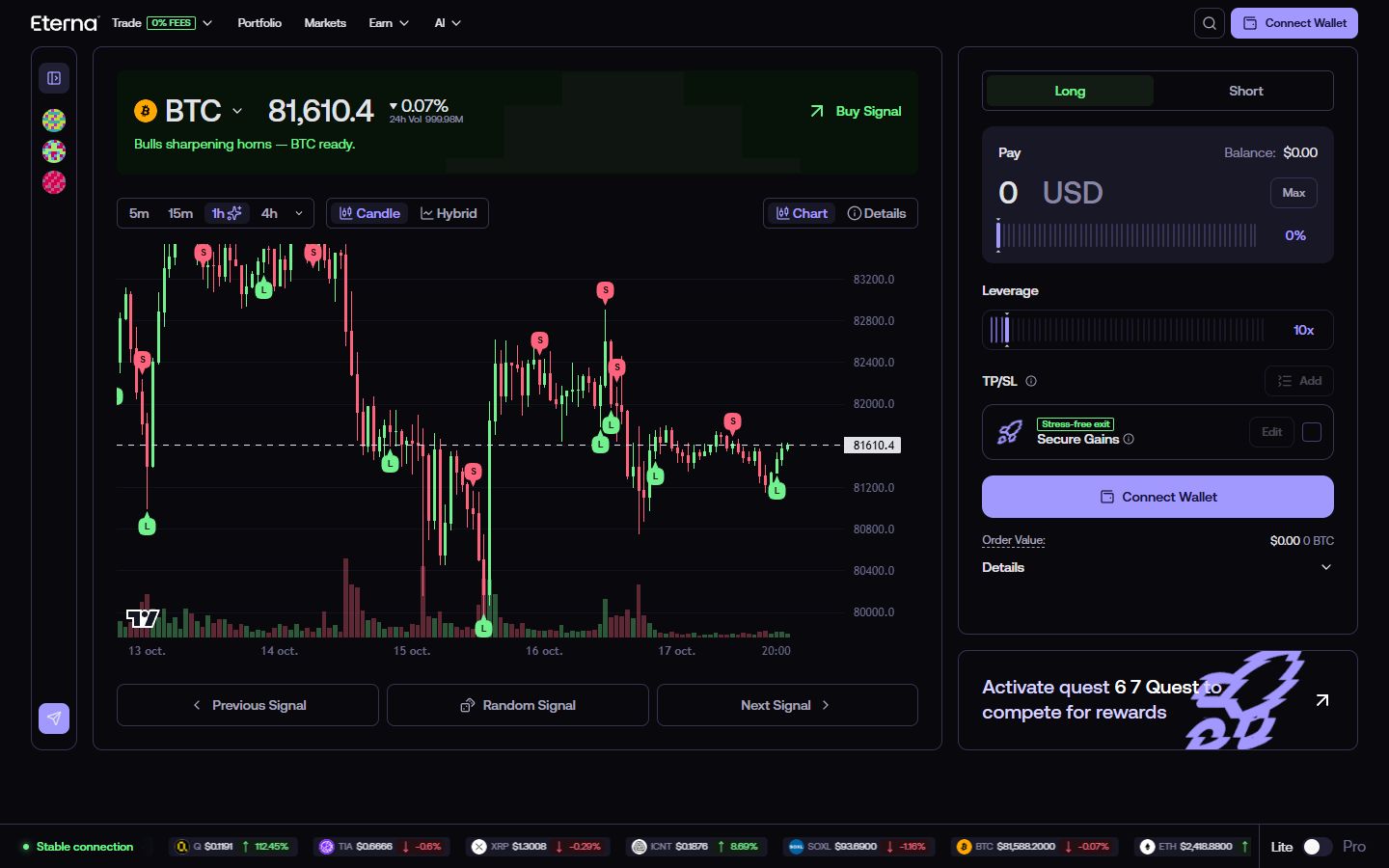
Eterna’s official BTC market page advertises buy and sell signals alongside its market presentation. Having a signal close to the chart can make discovery simpler than switching between a chat group and an exchange. Check the current application for supported markets, settings and access conditions.
This article is a guide, not a live signal feed. We have not verified an audited win rate, a complete signal history or a consistently profitable strategy for Eterna Signals.
Three ways to use crypto signals
- Integrated chart signals: convenient for discovering possible setups in the trading interface.
- Your own alerts: useful when you can explain and reproduce the rules that trigger them.
- External signal providers: potentially convenient, but evaluate full results rather than selected winning screenshots.
For example, OKX documents TradingView alerts connected to Signal Bots. Alert delivery and automatic execution are separate from generating a good trade idea.
What to ask before following a signal
- Was the entry visible in real time, or added retrospectively?
- Can the signal disappear or change before the candle closes?
- What is the stop, invalidation condition and intended exit?
- Does the history include every loss, fees, funding and slippage?
- How large was the worst drawdown and how many trades were observed?
Turn a signal into a sized trade
Illustrative linear-contract example: a $1,000 account risking 1% has a $10 risk budget before costs. An entry at $60,000 with a stop at $59,000 implies 0.01 BTC, or $600 notional. Leverage changes the initial margin requirement, not that price-distance loss on the same quantity. Stops may execute worse than requested.
Use the position size calculator, then check funding and break-even after fees.
Matches the hypothetical setup above; fees and slippage excluded.
Read an Eterna Signal in five steps
- Identify the instrument. Check the symbol, contract and chart timeframe. A BTC spot chart and BTC perpetual contract are not interchangeable.
- Record what you saw. Note the marker direction, candle time and whether the candle is closed. The dated capture above shows the interface; it does not establish when a marker first appeared.
- Write the invalidation. Decide what observation would invalidate your idea before choosing a position size. A chart marker by itself does not supply a complete exit plan.
- Calculate the exposure. Use entry, stop and risk budget in the position-size calculator. Check quantity units and exchange minimums before copying anything to an order ticket.
- Review the order separately. Verify direction, margin mode, leverage and exit controls. Seeing a signal does not require placing an order.
Worked example: from a marker to a risk budget
Suppose a hypothetical long plan uses entry $60,000, stop $59,000 and target $62,000. With $1,000 equity and 1% risk before costs, the budget is $10 and the quantity is 0.01 BTC. The planned target would produce $20 gross; the stop-distance loss would be $10 before costs. This is an invented teaching example, not an Eterna signal.
At an illustrative 0.035% taker rate on both fills, entry commission is $0.21. Exit commission at the target is $0.217, leaving $19.573 before funding and slippage. At the stop, exit commission is $0.2065, so the loss becomes $10.4165 before funding and slippage. To keep a strict $10 total budget, allow for costs when sizing.
Build a record that includes the losing signals
Use a journal with symbol, timeframe, first-observed timestamp, entry rule, invalidation, exit rule, costs and outcome. Record skipped and changed markers too. A screenshot taken after a move cannot establish real-time availability or whether an indicator repaints.
Keep forward observations separate from historical examples. Compare average win and loss, net expectancy and drawdown, not just win rate. For illustration, a 60% win rate with $5 average wins and $10 average losses has a negative $1 expectancy per trade before costs. No complete Eterna signal performance dataset has been verified for this guide.
Integrated markers or external alerts?
Use integrated markers to investigate ideas in context. If you already have reproducible rules, an alert workflow may fit better: the OKX documentation describes connecting TradingView signals to a bot. In either case, distinguish discovery, alert delivery and execution; success at one does not prove the others.
Where AI agents fit
An agent can help organize market information or prepare an order. Before connecting a signal to execution, define position limits, permissions and a way to stop the process. Read our AI trading tools guide. Automation makes a rule faster to execute; it does not prove that the rule has an edge.
Explore the product behind the thesis
Start with the exchange, its current features and your regional eligibility.
Explore Eterna